Millions of people from all walks of life require frequent prescription injections. Discreetly carrying medical supplies can be difficult. Prescribed injections are often life-saving, so Stealth Bros & Cohas designed products to make doing it easier and more fashionable.
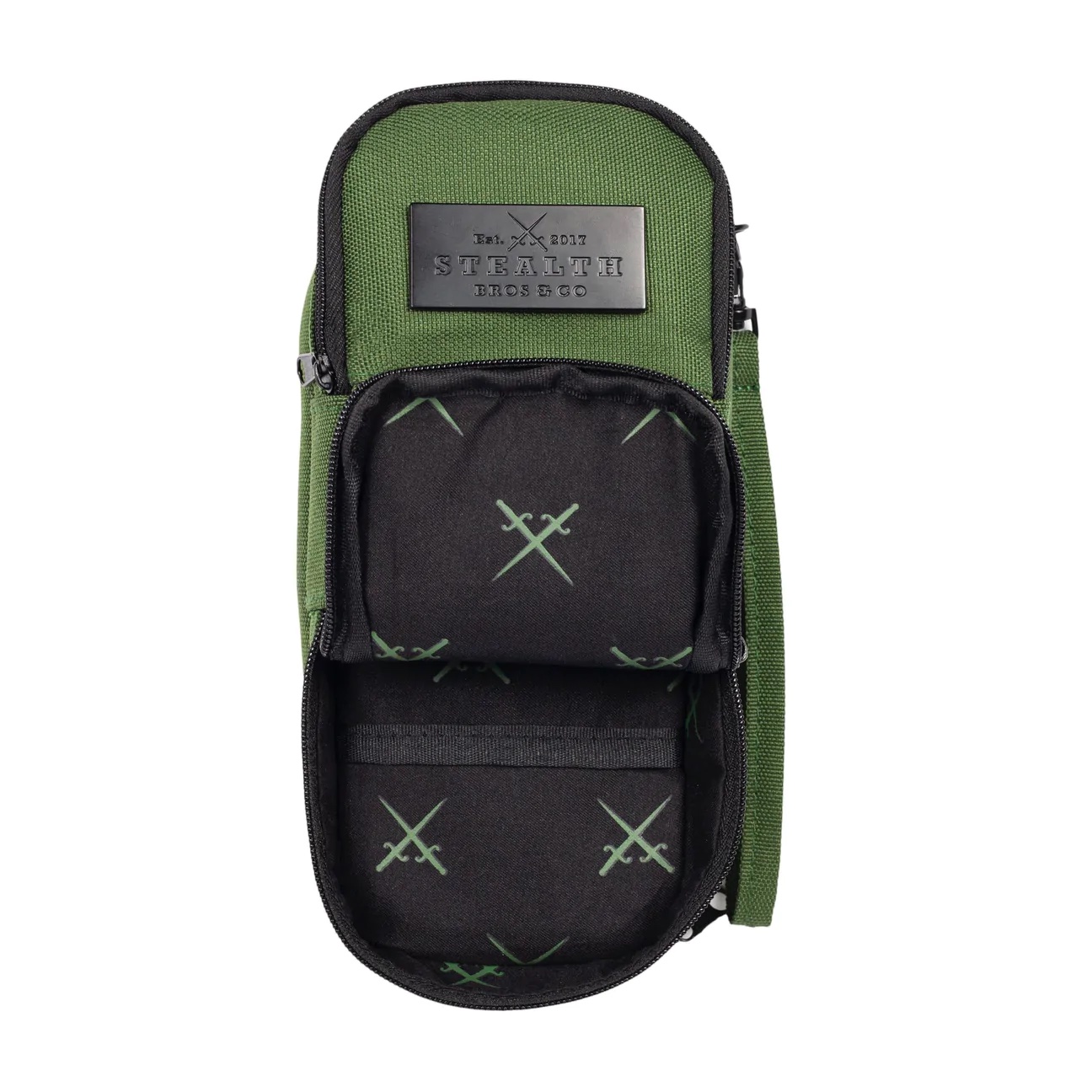
Stealth Bros & Co has a line of stylish carry bags for all of your medical supplies. They currently have two styles: Original Dopp and Jr Dopp. No need to throw your supplies in a purse, fanny pack, makeup bag, or pencil case. These Dopp kits and Stealth Sharp Shuttles revolutionize injections on the go.
Stealth Bros & Co is a transgender-owned and operated company. They are dedicated to providing folks on hormone replacement therapy a way to organize and accessorize the most important day of the week–shot day.
When it comes to taking your scheduled hormone dose, you should be organized, confident, and excited. The last thing you want is to sacrifice style and convenience. You can have the best of both worlds with the Original Dopp or Jr Dopp.
Although their products were originally created for the transgender community, Stealth Bros & Co is proudly helping people from all walks of life. From insulin and fertility to any other medical injections, their products do not discriminate.
The Dopp kits look more like toiletry bags than med kits. Carry everything you need in one handsome place. They’re water-resistant, and Vegan friendly.
Prominent zipper compartment large enough to hold syringes, needles, vials of medicine, makeup, gender prosthetics, and more. There’s even enough room to throw in a few Stealth Sharp Shuttles, too!
A zipper pocket on the front of the Dopp is perfect for carrying bandaids, alcohol swabs, and a lollipop when you take your shot like a champ!
The largest zipper compartment will fit several needles, syringes, vials, and a Stealth Sharp Shuttle.
On the top, there are two small zipper pockets. One of them features a pocket that spans the length of the kit. It is the perfect size for your Stealth Sharp Shuttle.
Durable clip-on wrist lanyard.
Both kits come in various colors to fit your style. Internal material displays the two iconic swords from the Stealth Bros & Co logo. The inside logo corresponds to the color of the kit.
A portion of product sales is dedicated to the Stealth Bros & Co Support Fund (SBSF.) Founded in 2018, SBSF is an opportunity to help LGBT+ folks in need. Funds can be used to pay for gender-affirming care, including hormone replacement therapy, surgery, and other medical needs.
Whether you’re a frequent traveler or using the product at home, you can’t go wrong with a Stealth Bros & Co Dopp. Taking your doses isn’t something most people want to publicly advertise. Thanks to these products, you’ll have peace of mind carrying your supplies undetected.
Several years ago, I learned the hard way the importance of unique passwords. I used a note-taking app on my phone to keep all of my internet login information. Most of my passwords were the same, or they differed very little between accounts.
When my phone was hacked, so was my entire digital life.
It took years—yes, you read that right, years—to recover from. You don’t realize just how many accounts you use until you can’t get into any of them.
In a world where most of our lives revolve around the internet, it’s essential to keep your digital life secure. The foundation for all digital security is the password you assign to your digital assets.
Here’s how to optimize your security by perfecting your password creation:
Never Reuse a Password
This is the golden rule of password creation. Most people reuse a single password for most of their accounts out of convenience. The easiest way for a hacker to take control of your digital life is by guessing the single password you use for all of your accounts.
The scary part about this is if a hacker gets one of your passwords correct, they have everything. This could have devastating effects. By forming good password habits, your digital life will be far more secure.
Side note: this also applies to your devices! If you have a smartphone, laptop, and tablet, don’t use the same password for any of them!
How to Create a Secure Password
Many people tell me, “I don’t want to use different passwords. I’ll never remember them all!” While it does seem daunting to make an original password for everything you use, it’s not as complicated as it appears. You can still make them memorable while maintaining variety.
How to create passwords like a pro:
Use letters (both capital and lowercase), numbers, and symbols.
This gives you the best chance to slow down a hacker using a tool based on trial and error.
Substitute letters for numbers and symbols. For example, the word “Beautiful” could be written as “B3@u7!fuL”
Make it memorable
You can still make your password the name of your pet and the year you graduated high school. It’s all about how you format it.
Make rules for yourself. The rules could be as simple as always using the same symbols for certain letters (ex. @ for the letter A,) or more complex like alternating numbers and symbols between every three letters. The possibilities are endless, and you can make it however complex you desire. Just keep in mind that the more complex, the stronger the password.
The longer, the stronger.
Ever wonder why websites force you to have eight or more characters for a password? The longer the password, the harder it is to crack. If you can remember a thirty-six-digit password, you’re much less likely to be hacked. That length is not generally easy to remember, but there’s still a way! Increase password length by making it into sentences (using your personal rules). You can format “I like eating pie” into “IL!k3e@7inGP1E” Notice how there are four I’s in the sentence, but they are now all different?
Avoid repeating characters
Similar to how you should avoid reusing passwords, avoid repeating characters. In my last point, we used different characters that all stood for the letter I. By mastering the use of letters, numbers, and symbols, you’ll never have to worry about repetition!
Consider a Password Manager
Ditch the sticky notes hanging from your computer monitor and organize your passwords efficiently. If creating and remembering all of your passwords seems like an insurmountable task, have no fear! Password managers are here.
Password managers are encrypted services to hold all of your passwords in a secure and accessible place. They remember the passwords so you don’t have to. Many of them also assist you in generating new passwords.
After getting hacked, I turned to 1Password to keep all of my passwords in one organized place. It’s free for one device and I’ve used it for years.
I have over three hundred passwords saved in 1Password, each unique.
Now that you’re a pro at making passwords, you should feel more confident in the security of your digital life. Avoid the trap of redundancy, unleash your creativity to make strong and memorable passwords, and store them somewhere safe. You’ll go forward from here wondering why you ever did it any differently.
Staying calm under pressure is a rare yet essential skill. As a security officer at an automotive manufacturing plant, I deal with many medical emergencies because the plant is quite dangerous. This has forced me to compose myself under pressure.
One day, I was on patrol and we were notified of a medical emergency in the paint department. I arrived on the scene to find a man holding his profusely bleeding hand above his head. His hand was wrapped in towels and he was holding it above his head to slow the bleeding.
Witnesses on the scene reported that his hand was nearly cut off, though I could not see it because of the towels.
I immediately set down my first aid backpack and put on latex gloves. I notified security dispatch to call an ambulance and send it to Gate 10. That specific gate was the closest entrance on the property to access our location.
My coworker and I loaded the bleeding man onto our security vehicle and drove full speed to Gate 10 where EMS, Fire Rescue, and Police were waiting. On the way, I assisted the man by supporting his arm to ensure his hand remained above his head.
The man was surprisingly calm and told me that he was using an industrial paint scraper to deep clean one of the paint booths. It slipped, and his hand took the beating.
Upon arrival at Gate 10, I assisted the man into the ambulance and my coworker spoke to the police. Shortly after, the security supervisor arrived and I calmly explained the situation. She told me I did a good job.
After EMS, Fire Rescue, and Police cleared the scene, my coworker and I worked to clean the blood off of our vehicle and ourselves. We will never know if the man got to keep his hand.
How Customer Service Taught me to Keep Composure
I often think back to this day and wonder how different the situation would have been if I wasn’t good under pressure. I was never trained to be, I believe I was born this way.
There’s nothing that can truly prepare you to render aid to a severely injured person, or to save someone’s life.
Sure, my private security license requires that I’m certified in CPR and the use of an AED. However, having those certifications doesn’t necessarily mean you’re going to be calm in a medical emergency.
If I had to attribute any experience to my ability to remain calm under pressure, it would be from my time working in a customer service call center. I often dealt with extremely upset customers and needed to maintain my composure.
To get through those difficult calls, I would remind myself of several things: I’m on the phone with them, and they cannot physically harm me; This situation is only a fraction of my day, and it will be over soon; My job is to help the customer, and to ensure their problems are solved to the best of my ability.
While it is normal for intense situations to be mentally draining, I always kept in mind that it was temporary. Ultimately, the objection was to problem-solve and complete a specific goal. If I did my best, the goal was accomplished.
This same mentality can be applied to customer service, medical emergencies, project deadlines, or public speaking and presentations. Sometimes the only way out is through, but you’ll eventually look back and be proud of what you’ve done.
3 Essential Steps to Keeping Your Composure
Although it is instinctual to me, staying calm under pressure can be methodical.
Here is how I delineate it:
1. Focus on the task, and do not let your mind invent possible negative outcomes.
– Avoid psyching yourself out. If you begin catastrophizing, you will sacrifice your performance. When I have deadlines approaching, panicking about all I have left to do and what if I don’t get it done on time, will just hold me back. Take it one step at a time, and you’ll easily meet the deadline.
2. Know your limits and work around them.
– Everyone has their limits. It does not make you weak or incapable unless you are unable to persevere. For instance, I knew if I saw the patient’s nearly severed hand, I would have struggled to provide aid. The sight of blood did not bother me, but I knew my limits. So I never looked at his hand and was able to do my job.
3. Organization aids in maintaining composure.
– If you are not organized during high-stress situations, you are more likely to panic and make an error. When an angry caller screamed in my ear, the entire interaction would improve if I was organized. Being organized allowed me to work faster and more confidently. Conversely, if I didn’t know how to solve the problem, or what tools would assist in doing so, the customer would pick up on it and become angrier.
The ability to stay calm under pressure has been invaluable throughout my professional and personal life. It is a skill that must be exercised to get it right. Ultimately, it is the skill I have utilized more than any other.
Over the last couple of years, businesses, and the entire world, have had to find ways to adapt to a global pandemic. From medical breakthroughs, and finding ways to make money in a time when the world stood still, to educating students of all ages from afar, the world underwent many changes. Furthermore, business operations had to work around COVID-19 restrictions to keep the money flowing.
Businesses had to switch much of their work to remote locations; new software and tech tools were created to manage workloads of unparalleled proportions; online sales became the sole crutch of markets, and customer service became polished versions of existing functions, whilst sometimes providing the only human contact presently available.
Perseverance is something habitual we all developed, some excelled and many faltered. Hindsight provides a unique perspective to creating new normals within unprecedented times.
Here are three examples of perseverance in business:
Healthcare:
Telehealth vs. In-Office Visits
As a person who never heard of Telehealth before the pandemic, I was skeptical when initially using it. Now, years after the outbreak and months into the calm, I find myself preferring Telehealth for many reasons. This is what Telehealth did for the world:
Telehealth, for those that may not know, is a video or audio call with your healthcare provider. During the worst of COVID-19, this provided a safe way to meet with your doctor without posing risk to yourself or others. For appointments not requiring a physical examination, Telehealth changed the game.
Appointments for prescription management, talk therapy, and a myriad of other healthcare needs became living-room conversations. New HIPAA protocols had to be written to allow these sensitive topics to be discussed by internet and phone. Software for signing documents became essential for what was previously exclusively pen-on-paper or faxed documentation.
Dining and Grocery Shopping:
Curbside and Delivery
Before the lockdowns, I would rarely even have a pizza delivered to my home. When businesses closed their doors or limited occupancy, curbside pickup and delivery options became the only alternative to home cooking.
Services such as Uber Eats, DoorDash, Instacart, and Amazon Fresh became more than a convenience. While employees categorized as Essential still did the work behind the scenes, consumers seldom had to interact with aspects of businesses once centered around in-person operations.
Performing Arts:
Concerts and Plays
Being a musician or a theater performer during the COVID-19 pandemic was a major challenge, to say the least. Audiences could no longer gather in the same place to enjoy these art forms. Again, technological alternatives became popular in keeping the world of performing arts afloat.
To maintain the flow of profit and to ensure artists were compensated for their hard work, selling tickets for shows suddenly shifted. Concerts and plays became exclusive online live streams, accessible upon purchase. Sale of merchandise and even virtual meet-and-greets supported their art until in-person options returned.
Perseverance Here to Stay
Many of these adaptations remain, whether by convenience or demand. However, while we may all consider ourselves lucky to not always require such drastic changes, we should take the skill of perseverance with us. Applicable to all walks of life, but particularly in business operations, it is a skill that once mastered, will have no equal.
The business world is ever-changing. Albeit, not always as fast as it did during COVID-19, the ability to adapt will always be paramount. Operations will need to continue persevering to keep their businesses running, whether it be during a pandemic, or just staying ahead of the competition.
One of the best ways to market anything these days is through social media. I have substantial experience running one of the most successful LGBT+ Instagram accounts from several years ago. This was a personal challenge through which I learned how to gain popularity and extend viewer reach on Instagram.
Where It Began
It all started in 2017 when my friend asked me to take over his Instagram account for one week during a summer band camp. When he handed me the reins to his account, @LGBTMOTIVATE, he had 4,825 followers. When he returned, he was blown away at the account’s growth, which gained almost a thousand followers.
A couple of weeks later, he asked me if I wanted to permanently be an account administrator. I was honored that he was impressed enough to offer me the position. Mind you, this was not something either of us made money from, but it was great fun.
@LGBTMOTIVATE profile picture designed and updated on July 4th, 2018 by Ves Slone
By the one-year anniversary of creating the account, we gained 13.2k followers. This was accomplished by consistently posting new content throughout the day, using plenty of hashtags on every post, and interacting with incoming comments and direct messages in a timely manner.
Our content mainly centered around memes and mental health tips. When followers would message us for advice, we offered what we could, or referred them to crisis helplines.
How Quotas Impacted Our Growth
Eventually, we expanded to have as many as five different account admins at a time. Acquiring more admins enabled us to split the daily workload. To keep everyone motivated, I decided to implement a post quota.
The quota was designed to ensure all admins posted daily, and a weekly ranking system was created to achieve this goal. Ranks were announced to admins on Saturday. The ranks were categorized as follows:
Senior: Two posts a day, totaling fourteen posts in one week.
Intermediate: One post a day, totaling seven posts in one week.
Junior: Four posts in one week.
Under Junior: Less than four posts in one week.
Rank “Under Junior” allotted one week to bring up their post rate, or admin privileges would be revoked.
The quota was effective, as most of the admins were consistently Intermediate rank or higher. The need for such high quotas changed if we acquired more than five admins. As I’ll explain shortly, this was to avoid overwhelming our followers with content.
One thing we struggled with was how to reward admins for their achievements. Given our geographical differences and the fact that we weren’t doing this for money, rewarding good behavior was difficult.
One method we used to recognize success was to shout out whoever performed the best that week. This usually took place in our private admin group chat, but sometimes we’d do a public shout-out if the admin went above and beyond. This was just a pat on the back reward, but it’s all we could do.
Whenever someone did not meet the post quota, we would identify their pitfalls, advise them on how to improve, and then monitor their performance. After one week, if they did not improve, we would revoke their admin duties and search for a replacement.
Steps to Improve Viewer Reach for Free
1. Post frequently
Make three to five posts a day, and spread them apart by an hour or more. If you post several at once, people are less likely to interact with your content because you’re spamming them. By spacing out your posts, your followers will see you several times throughout the day, giving them more opportunities to engage with your content.
2. Use hashtags
The maximum on Instagram is thirty hashtags per post. Any more than that and they automatically delete. Consistently tag your posts, and make sure the hashtags are relevant. You may want to change some of the tags on each post to reflect your content.
The best way to add thirty hashtags to your posts is to save the tags in a note-taking app and copy/paste them into the caption or a separate comment. Using a separate comment looks better than the caption because comments are normally hidden when you’re scrolling unless you specifically click on the comment section. You don’t have to use all thirty tags, but if you want the maximum reach, it’s your best bet.
3. Interact with smaller accounts
Like and comment on posts that share hashtags with yours. It’s best to do this on content from small accounts so they’re more likely to notice your activity. Furthermore, small accounts will often look at your page and may end up following.
If you solely interact with large successful accounts, they are less likely to notice your activity. Your interactions may be lost within the flood of their notifications; they simply have too many notifications to even see you.
That being said, don’t just post annoying advertising comments like, “Love your pic! Check out our page!” No one wants to interact with those. They’ll assume you’re a bot and report you for spam. It’s better to post a relevant, creative comment and let your wit draw them in.
Paid Options for Growth
Now that we’ve covered free options to gain followers, let’s discuss paying for advertising. Instagram also offers paid promotions that will place your posts directly in a person’s home feed. You can set these up using a business account, and you can also tie your Instagram to your business FaceBook page.
If you use several social media accounts for your content, there’s a way to simultaneously post to them at once. The latter requires a quick login for each social media platform to allow posting. Most other social media platforms also offer paid promotion, so look further into that if you’re interested.
Is Paid Promotion Necessary?
Paying to promote your content may be favorable and effective for those with the means. However, as illustrated above, keep in mind that spending money isn’t always required for gaining a large audience.
For @LGBTMOTIVATE, we never paid for ads. It goes to show that spending money is not always necessary to expand your following. You just have to be dedicated and consistent.
The Outcome
In 2019 when we all stopped posting on @LGBTMOTIVATE, we had 40k followers. That’s a 729% increase from the first week I posted on the account in the summer of 2017. If you visit the page now, most of the posts have been archived or deleted at the discretion of the account owner.
Even though the account has been retired, we may someday revive it. If we do, we’ll certainly use some of the same techniques to make it successful once more.
A sales representative once told me, “If you promise not to buy anything, I promise not to sell it to you.” To some, this may sound counterproductive, yet this built trust between the salesperson and myself. This simple approach removed the obligation of purchasing and allowed me to see it differently.
People don’t want to feel like they have to purchase a product or service. On the contrary, they want to feel excited about purchasing! You just have to show them that their lives would improve in some way by owning what you’re selling.
Why Assist Rather Than Sell
Sales shouldn’t solely be about making money. Money is just a by-product of doing a good job. Sales should ultimately be about helping people, not about taking advantage of them.
Every person you interact with is going to have unique circumstances. As a sales representative, it’s your job to show them how your products and services can aid in achieving their goals.
If a potential customer feels pressured or obligated to make a purchase, then the salesperson has missed the mark. In sales, you’re an aspiration advocate; you take the customer’s dreams and provide tools to accomplish them.
How to Help
Your approach dictates success.
The best salespeople don’t push someone into making purchases. They ask open-ended questions, build rapport with their prospective customers, and learn their wants and needs.
To avoid pressuring your customers, you have to listen.
A successful salesperson doesn’t open a conversation by telling the customer what they need, they let the customer tell them. Once that is determined, you provide them with solutions tailored to fit their needs.
Build Rapport
Finally, building rapport with the people you contact is essential. It’s true, you’re there to sell to them, but they aren’t going to buy until they trust you.
When I worked as a Customer Service Representative for Apple, I sold a lot of products just because of the help I provided. Sales weren’t my job at the time, but customers would come to me frustrated and I would give them solutions. Once I gained their trust, they accepted my advice.
By working with them in a patient and compassionate manner, I built a connection with them. Then they would ask me what I recommended they buy. I provided them with those tailored options, and most of them ended up purchasing.
Implementation
So, if your company hasn’t taught you these basic principles, implement them and your metrics will soar. You’ll feel better about the work you’ve done, the success you’ve experienced, and of course, the money you’ve earned from it.
Always remember that the best way to sell is to give.
What I Learned About Customer Success Working for Apple
When I was a Customer Service Representative (CSR) on behalf of Apple, I encountered a diverse range of customer problems to solve. Apple’s training is intense and adequately prepares you for taking customer calls, but it’s impossible to prepare for every unique situation. However, Apple emphasizes research skills, so your resources are there to support you even when you get an unprecedented call.
There were a few tools we utilized the most. Apple’s website is a wealth of knowledge; most customers don’t even realize nearly everything they need can be accomplished on the website alone. The smaller percentage of issues that cannot be solved using Apple.com can be researched by the CSR in the database that houses all of Apple’s policies. There are probably thousands of policies in this database, but that allows for a myriad of solutions.
Taking A Step Further
One tool that CSRs have access to but are not trained on, is called GCRM. During any downtime between calls, I would research policies on this tool. I was comfortable enough with it that I often used it as a last resort for customer calls. GCRM allowed access to the notes of different departments other than customer service, enabling me to better understand the whole story behind an issue.
Some other departments could not access the customer service notes and vice versa. GCRM enabled me to leave information that other departments could see. This provided a vital communication link between the departments and allowed for problem resolution with fewer customer contacts.
I enjoyed using this extra resource because it meant that I satisfied more customers. The primary resources we are trained on allowed us to solve most problems, but the things I taught myself allowed me to go above and beyond average solutions.
Using What I Learned
For example, one customer contacted me regarding the theft of his vehicle containing three laptops and an iPad. I was saddened to know that his car and his expensive electronics, including all of their data, had been stolen. I was able to walk him through how to mark the products as “lost” on Apple’s device tracking service, called Find My, deeming his stolen laptops and iPad inoperable while protecting his data.
After that, he requested the serial numbers of the items for his insurance claim and police report. I was unable to see all of the stolen products in his purchase history. Some of them were purchased six years prior and I could only see fifteen months of purchase history. However, I opened up my GCRM and searched for his information.
I recalled that he mentioned he had contacted Apple Support for two of the laptops several years prior. After some digging, I found the AppleCare notes from long ago and was able to provide him with the serial numbers. He was elated! He said he was grateful just to disable them, but he thought it was a long shot to get their serial numbers, too. I was pleased to be able to go above and beyond to help.
How To Level Up Customer Experience
If you’re ever going to be successful working in customer service, you need to be able to think on your feet. Every customer interaction is a new puzzle. You may encounter a similar situation a hundred times, but customers may also come to you with a problem you could’ve never even imagined. It’s paramount that you know the products and services you’re representing and have the confidence to break down and solve every puzzle.
The world is ever-changing, and your company’s policies should adapt to that concept. If you try to memorize solutions, you risk repeating procedures that may no longer be relevant or effective. Instead, I encourage you to always know how to navigate your resources and get in the habit of double-checking your company’s policies and procedures before providing a customer with a solution.
Taking These Skills With Me
Overall, the character traits that enabled me to be successful in a CSR role are compassion and empathy, patience, creativity, research skills, keen attention to detail, and a passion for the products and services I was representing. These are things that I have carried with me beyond call center customer service, and I believe them to be invaluable skills for almost any job. Ultimately, the skills associated with a CSR role are an asset I will continue to utilize regardless of my job title.



 Ves Slone